The Tynewydd Pit Disaster
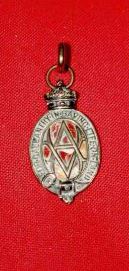
This photograph shows the Albert Medal that was awarded to John Williams for his part in the rescue of miners from the Tynewydd Pit, Porth in April 1877. Queen Victoria awarded the Albert Medal to the rescuers after their heroic efforts to save 5 miners trapped in the flooded pit for 10 days.
On 11th April 1877 flood water from a disused pit broke through into the Tynewyyd Pit - 4 men were drowned, 1 was killed by compressed air and 4 were rescued after a short period of time. The remaining 5 men were trapped in an air pocket. To rescue them miners had to cut through over 36 yards of coal. They worked four to a team in four hour shifts aware that when they broke through the compressed air would escape and the flood waters would rise. Over a 10-day period news of this daring rescue was reported in the Nation's newspapers. As the story of the rescue unfolded it touched the hearts of the nation, questions were raised in Parliament and the Queen herself asked to be kept informed of any new developments. When news of the successful rescue reached her ears she decreed that the rescuers should be awarded the Albert Medal - The highest award for civilian gallantry and until this time only awarded for bravery at sea.
The story of this Innundation and subsequent rescue is well documented in publications such as "Disaster at Tynewydd by Ken LLewellyn, The Illustrated London News, poems and hymns were written about it at the time and even today there is extracts from a CD album on YouTube. Read also The Tynewydd Colliery Tradegy of 1877 by Gareth Harris. They used to have a large display about the incident at the Rhondda Heritage Park - I hope it is still there!
The family story suggests that there are inaccuracies in a lot of these accounts and of course there may well be depending on who was recounting the tale of the rescue. Our family story relates that John "put his arse in the hole" to prevent compressed air escaping and stem the rise of the flood waters.
The team that broke through to the trapped miners were awarded the Albert Medal 1st class and the other rescuers the Albert Medal 2nd Class. Some accounts therefore seem to me to play down the valiant efforts played by everyone in performing this rescue. The miners who took it in shifts to hew their way through this large expanse of coal were chosen because of their fitness and strength not just their willingness to help. John was not even employed at this mine at the time of the rescue which would lead one to believe that these miners were also willing to give up their wages in order to help others.
28 April 1877 - The Cardiff Times reported "Lest there should be any misapprehension as to who the noble fellows are whom we have to thank in the largest measure for the release of the five men alive it may be as well to explain that the four shifts of four men each who worked for 3 hours alternately during the whole time till the last few hours of the struggle were:
1st Shift - Isaac Pride, William Rawlins, Charles Ostridge and William Morgan.
2nd Shift - Davy Davies, John Morgan, Thomas Rees and Davy Minton.
3rd Shift- A Jones, Richard Hopkins, John Howells and Thomas Jones.
4th Shift - John Griffiths, Thomas Griffiths, Ioan Williams and Thomas Thomas.
The exertions of these men, which have been most arduous, escaped notice to some extent for the following reason; Having worked the whole time, towards the closing of the week they became seriously exhausted. They were worn out, in fact, before they left the perilous task and were not in fit condition to tackle the job when the locality had suddenly become a more dangerous place than usual by the reason of the quantity of gas near the face of the heading. Volunteers came forward - the men whose names have been given - and while to them falls the honour of having actually brought their comrades out alive the services of the others must not be overlooked.
The rescuers received the Albert Medal, a gold watch, a bible and a purse of money for their endeavours. Thousands of people turned up to watch the rescuers receive their medals on the mountainside above Pontypridd. Some of the medals are on display at The Big Pit Mining Museum , another is in the National Museum in Cardiff but John's medal, bible and watch can be seen on display in the museum set up in the old Baptist Chapel in Pontypridd near the Old Bridge.
Incidentally in many of the accounts you will see John's name written the Welsh way - Ioan Williams. I have found a newspaper cutting about the distribution of the Relief monies raised and it would appear that John and the other rescuers were awarded 6s a day for each day worked - so 10 days worked = 60s = £3.00


